A Sea-and-Shore Reading Afternoon
Plan a sea-and-shore reading afternoon with VMU maritime history and casino fiction, then compare how each text shapes its setting without blurring fact and invention.
The common mistake in a sea-and-shore reading afternoon is pairing a ship passage with a casino scene simply because both involve travel or risk. That can make a port sound like a novelist’s gaming room, or make fiction seem like a record of maritime life. A more useful pairing starts with a specific question about how writers make places legible.
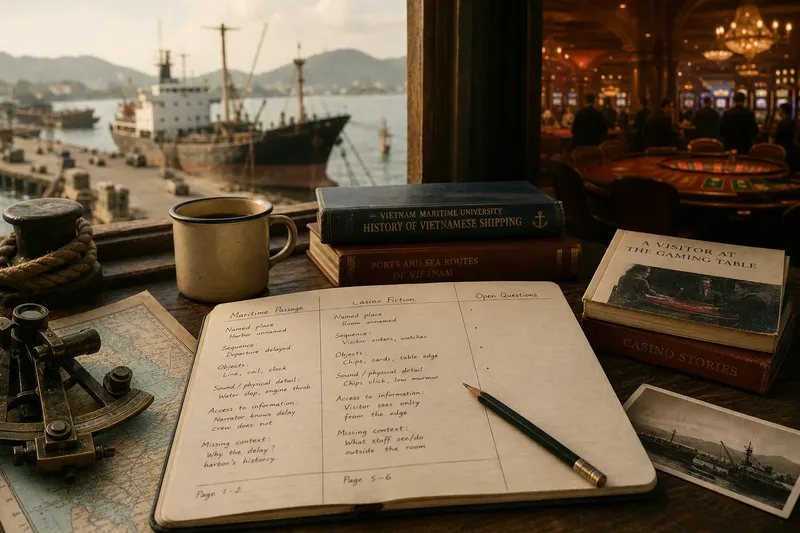
For a reading session focused on VMU maritime history and casino fiction, set out the passages, a pencil, and one sheet of paper. Track what each text lets its reader see, hear, and know. Think of the page as a chart: it marks a route through a scene, but it is not the territory itself.
Choose passages that reveal a particular viewpoint
For the maritime selection, choose a focused passage from a voyage narrative, sailor’s memoir, port history, or material connected with the history of Trường Đại học Hàng hải Việt Nam. Look for a scene centered on a place, task, or event: a vessel preparing to leave harbor, work aboard ship, or a stop along a route. Keep the passage’s source and purpose in view; a memoir, institutional history, and travel account do not offer the same kind of perspective.
For the casino selection, choose a contained scene from fiction. A character entering a room, watching a game, or deciding where to sit gives you a clear line to follow. The texts do not need a shared subject. Their value may lie in the different ways they organize attention.
Write each title and page reference at the top of separate columns. Leave a third column for open questions. That space makes it easier to separate a detail stated on the page from a conclusion you are drawing.
Use the same evidence checks for both passages
Keep notes brief: a phrase, a page reference, and a decision about what the detail supports. If a passage does not answer a question, record the gap rather than filling it with general assumptions.
- Named place: Check whether the text names a harbor, vessel, room, or other location. If it does, record the name and use it to discuss that passage’s setting; if it does not, describe the place as unnamed rather than guessing where it is.
- Sequence: Check which event changes the scene. If the order is clear, note how it shapes the reader’s understanding; if the order is uncertain, mark the gap instead of inventing a timeline.
- Objects: Check whether a chart, tool, ticket, table, or other object affects an action. If its role is explained, include that function in your notes; if it appears only as background, treat it as atmosphere rather than proof of how a real place worked.
- Sound and physical detail: Check which sounds or sensations the writer names. If a detail changes the mood or pace, note that effect; if the passage offers none, focus on the other devices it uses.
- Access to information: Check what the narrator knows compared with what a character knows. If there is a difference, consider whether it creates suspense or explanation; if not, describe the viewpoint as shared rather than claiming hidden information.
- Missing context: Check whether the passage leaves a historical or practical question open. If it does, name the kind of source that might answer it; if it does not, cite the passage and avoid extending its claim beyond its stated scope.
Read for the scene before analyzing its craft
On the first read, follow the scene without trying to make the two texts match. Mark where each passage begins and ends, then note the main event. Either reading order works; starting with the maritime selection may help establish its place and sequence before you turn to the fictional casino scene.
On the second read, pause where a detail changes your understanding. A voyage account might shift from a task to a delay; a casino scene might shift attention from the room to a character’s choice. Ask what the passage shows and what it leaves outside the frame.
Say you have an invented memoir excerpt about a crew member waiting for a vessel to depart and an invented novel excerpt about a visitor watching a game from the edge of a room. Start with the memoir’s two stated details: the departure is delayed, and the harbor’s wider history is not explained. Record both, then decide that the excerpt supports a claim about waiting in that scene, not a claim about the harbor’s history. In the novel, record the visitor’s position and the fact that staff remain outside the scene; decide that the narration limits what the reader sees. Your comparison can then be precise: the memoir names a practical reason for waiting, while the novel focuses on a visitor’s restricted view. Neither detail establishes how every port or casino operates.
Compare the writers without forcing a shared theme
Circle one detail from each passage that most shapes the setting. Write a sentence about the difference: one text may arrange events in sequence, while the other may stay close to a character’s attention. Keep the page references beside the sentence so you can trace each point back to its source.
Then look for a real point of contact. Both writers might delay an explanation or make a threshold matter. If no connection holds up, record the difference and stop there. An honest boundary is more useful than a resemblance created for the sake of the exercise.
Keep literary invention distinct from historical description. Casino fiction can support a discussion of pacing, mood, and point of view, but it cannot by itself document a real gaming room. A memoir or port history also has limits: it reflects its author, purpose, and scope. Treating each source according to what it can support makes a VMU maritime history and casino fiction comparison clearer.
What should readers choose and record?
How long should each passage be?
Choose an excerpt short enough to reread while preserving the scene’s context. If an event depends on something introduced earlier, include enough surrounding text to understand that connection.
Which maritime sources suit this comparison?
A voyage narrative, sailor’s memoir, port history, or relevant VMU historical material can work if it centers on a clear place, task, or event. Note the source type, since a personal account and an institutional history frame evidence differently.
Can casino fiction establish maritime or casino history?
It can help you discuss literary choices such as setting, sequence, and viewpoint. It cannot, on its own, verify how actual ports or casinos operated or how people behaved there.
What if the two passages have little in common?
Compare the difference that most affects how each scene reads, then state where the comparison ends. Do not invent a shared theme to make the pairing seem stronger.
Keep one unanswered question with your notes
At the bottom of the page, write one question the passages cannot settle and identify what kind of source could help. A port history may suit a question about a documented place; another literary work may help you examine a writer’s recurring technique.
Keep the notes with the books or reading materials. For a sea-and-shore reading afternoon, the most useful result is a clear account of what the texts show, what their viewpoints leave out, and which source you would consult next.