How to Make a Casino Ship Feel Like a Ship
Casino ship fiction feels sharper when the vessel’s route, routines, and changing access shape the plot instead of making the ship a static casino room.
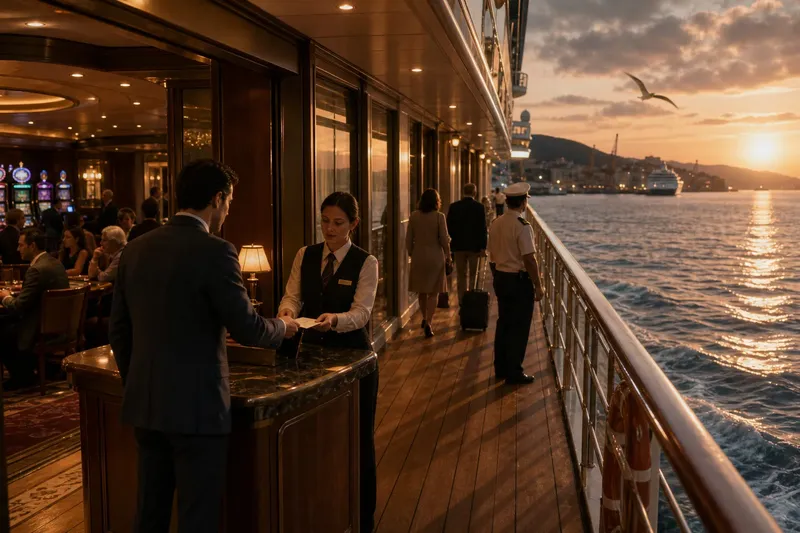
The most common mistake in casino ship fiction is treating the vessel like a casino building with water outside; the cost is a setting that could stay in one place without changing the story. A ship’s route, confined rooms, and changing access can shape what characters can do. Give those conditions a job in the plot, and the vessel becomes more than scenery.
That focus also separates a casino ship from a port-city story. A ship carries its social world along a route, while a port is a point of contact with shore. The useful question is not simply where a scene happens, but how being aboard changes its possibilities.
Make the casino ship’s movement matter
A vessel’s movement can alter a character’s options without requiring dramatic weather or a crisis. Departure may close off an easy return to shore; a scheduled stop may bring new passengers aboard; a stretch underway can keep the same people sharing lounges, passageways, and dining spaces.
Choose details that follow from the ship’s status. A vessel at berth has a visible connection to shore. One at anchor may rely on a tender for access. Underway, it is moving along its route, and the deck, windows, and announcements can remind readers that the setting is changing even when a scene stays indoors.
Think of the ship as a train carriage whose shared corridor keeps familiar faces close, except the route and the water beyond the windows give the journey its own character. The analogy is only a prompt: a ship has its own crew, spaces, and relationship to the harbor.
Build tension from shipboard routines and access
A casino lounge is part of a larger vessel. The plot can use the contrast between a public room, a passageway, a cabin, and a working area, while recognizing that not every character can enter every space. Passengers, crew, and visitors may have different reasons to be aboard and different access to its rooms.
Routines provide natural points of friction. A character might need to meet someone before a meal, locate a companion after a game, or decide whether to approach a crew member during a busy task. These small constraints feel more specific than having the ship behave like a hotel with unlimited access.
Say you are writing an invented scene aboard a casino vessel that has just left a harbor. A passenger has a folded note and wants to pass it to a crew member who works outside the public lounge. The passenger first checks the posted passenger areas, then asks a lounge attendant where visitors may wait, and finally leaves the note with that attendant for the crew member. The observable result is a plausible delay and a witness to the handoff; the writer can decide whether that witness creates suspicion or simply makes the exchange harder to keep private.
Use route changes to reshape the cast
A port call can change who shares the ship without turning the story into a port setting. New passengers may bring unfamiliar motives, while departing guests leave empty chairs and unfinished conversations behind. The vessel remains the central setting, but its social mix shifts as the route continues.
For a focused scene, decide which route event affects the characters: boarding, departure, a stop, or the return toward shore. Then show one observable sign, such as luggage moving through a passageway or passengers gathering near an exit. Avoid making every route detail compete with the central action.
Check the vessel’s story logic before revising?
How does a casino ship differ from a casino on land?
The ship’s route and access conditions can alter the cast’s options from scene to scene. A land-based casino does not carry its guests away from the surrounding streets as the vessel travels.
What details make a casino ship setting convincing?
Use details tied to the vessel, such as deck access, passenger areas, crew routines, and visible changes in the route. Choose only the details that affect the scene rather than listing ship features for their own sake.
Can the story include a port call without shifting focus ashore?
Yes. Treat boarding or departure as a change in the ship’s cast and access, then return attention to life aboard. A brief view of the quay can orient the reader without making the port the main setting.
How can I keep shipboard access clear?
State who is aboard, which areas they can enter, and how they move between them. If a character needs permission or help, show that interaction before placing them in a restricted space.
Revise with concrete shipboard checks
Use this list while editing a scene. Each observation points to a choice, so the vessel’s conditions either support the action or call for a revision.
- Vessel status: If the scene says the ship is underway but characters casually step ashore, show an appropriate stop or change the action to keep them aboard.
- Route event: If boarding or departure changes the cast, show a passenger arriving or leaving; if it changes nothing, remove the event or connect it to a character’s decision.
- Passenger access: If a passenger enters a crew-only area without explanation, add permission or an escort; otherwise, move the exchange to a public space.
- Room function: If a lounge is asked to serve as a cabin, office, and ship-control space, separate the action into suitable locations or clarify the fictional arrangement.
- Movement between rooms: If a character appears in a new area with no transition, add a corridor, stairway, or other route; if the move is irrelevant, keep the character in the original room.
- Route detail: If scenery or an announcement affects a character’s choice, retain it; if it adds no consequence, cut it or give it a clear purpose.
- Witnesses: If a private exchange happens in a busy public room, show who might notice; if secrecy matters more, move the conversation somewhere the characters can plausibly use.
For a worked invented revision, imagine a scene starting with two passengers in a casino lounge, one folded note, and the vessel already underway. The writer first checks the ship’s status and keeps both passengers aboard. Next, the writer checks access and has them remain in the public lounge rather than enter a crew passage. Then the writer gives one passenger the note and has them ask the attendant to pass it to a crew member. The resulting scene has two passengers, one note, and one visible handoff; the writer can decide that the attendant’s presence creates a witness, or change the meeting to a permitted public area if privacy matters more.
For historical or operational detail, match the vessel and route to the period and setting you have chosen. Ships, onboard arrangements, and local procedures vary, so a specific scene should not assume every vessel handles access or port calls in the same way.
Let the route leave a mark on the plot
A casino ship earns its place in a story when movement and shared routines affect what characters can attempt. The most useful details are often small: a departure that removes an easy exit, a public lounge that adds witnesses, or a port call that changes who is aboard.
When revising casino ship fiction, check whether the route and the vessel’s access rules alter a character’s choice. If they do, keep those details close to the action; if they do not, simplify the scene until the ship feels like a lived-in setting rather than a stationary room afloat.