How Casino Games Traveled by Sea—and What the Records Can Prove
Casino games by sea leave different traces in logs, diaries, and port records. Learn how to judge what those records establish—and what they leave open.
The most common mistake in tracing casino games by sea is to treat a route on a chart as proof that a particular game traveled aboard. A ship’s record can place a vessel on a passage; it cannot, by itself, tell you what people played or how a game reached a new community. A stronger account follows the game’s changing rules and names, then asks what each source can actually support.
Follow each game through its own record trail
“Casino games” is a convenient modern grouping, not a single historical tradition. Baccarat, roulette, blackjack, and poker have distinct histories. Their names, rules, and settings changed over time, so a source about one game cannot establish the history of another.
Look for dated descriptions that name a game and explain how it was played. A rulebook may document a version of its rules; a newspaper notice may show that a named game was offered in a particular setting; a diary may describe a person playing it. These sources answer different questions, and none should be made to answer more than it records.
Older accounts may use a familiar name for rules that differ from a later version. Compare the described play, not just the label. If the rules are absent, say that the game’s form is uncertain rather than quietly matching it to a modern casino game.
Separate shared objects from shared traditions
Cards, dice, tables, and wagers appear in many kinds of play. Two games using the same objects are not necessarily related, and similar names do not prove that their rules or histories match. Materials are clues to investigate, not a route map for cultural transmission.
When reading a source, keep these details distinct:
- Name: If the source names a game, record the exact wording; if it only says “cards” or “gambling,” describe that broader activity without assigning a specific game.
- Rules: If it explains how play worked, compare those rules with the version under discussion; if it gives no rules, mark the game’s form as uncertain.
- Setting: If it identifies a ship, port, private room, or public venue, use that setting; if the location is missing, do not supply one from context.
- Players: If it identifies crew, passengers, or residents, name only the documented group; if it does not, leave the players unidentified.
- Journey: If a source links a person or game to a voyage, describe that link; if it only records a vessel’s arrival, do not claim the game was aboard.
- Local contact: If an account describes play with local participants, report the encounter; if it records arrival alone, do not infer cultural exchange.
- Later use: If a later source documents local play, describe that appearance; if no such source is available, leave adoption unclaimed.
Build a maritime link from records that meet
A ship’s log, passenger list, port entry, diary, and newspaper notice each preserve different kinds of information. A log can establish a vessel’s movements; a passenger list may identify a traveler; a diary can describe leisure. The useful question is whether records connect the same people, game, place, and period—not whether several sources merely mention the sea.
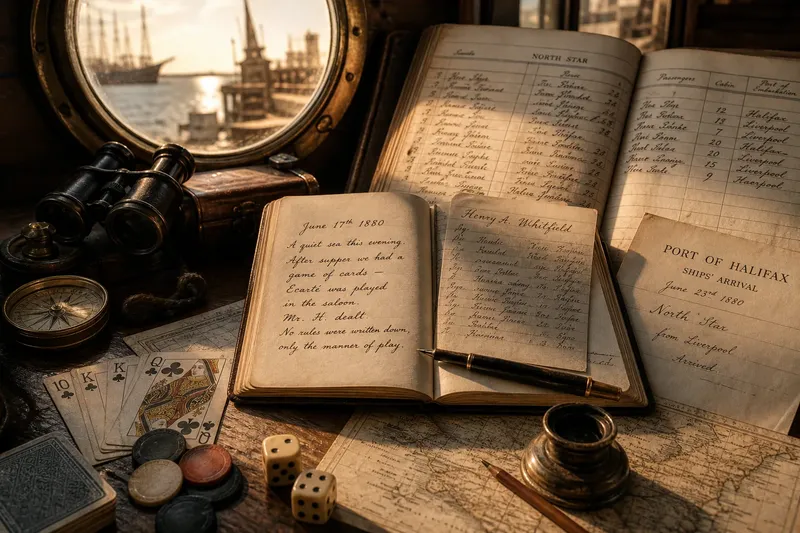
Imagine an invented case: a diary dated in 1880 names a card game played aboard the fictional vessel North Star; a passenger list for that vessel includes the diarist; and a port register records the ship’s arrival in Halifax. First, note the diary’s named game and the fact that it gives no rules. Next, use the passenger list to connect the diarist to the voyage, then use the port register to establish arrival. The supported result is that the diarist recorded playing the named game aboard a vessel that reached Halifax. Because the diary does not describe play with Halifax residents and no later local account is included, the records do not establish that the game was introduced or adopted there. The missing rules also leave its exact form unresolved.
This method does not require one flawless document. It requires matching claims to evidence and leaving gaps visible instead of filling them with a plausible story.
What can records of casino games by sea establish?
Does a ship’s route prove a game traveled aboard?
No. A route record establishes a vessel’s movement, not the leisure of everyone on board. A separate account linking a named game to a traveler on that voyage would support the narrower claim.
Does a reference to gambling identify a casino game?
No. “Gambling” describes an activity, not necessarily a particular game or venue. Use a specific game name only when the source provides one.
Can a game’s appearance in two ports prove it passed between them?
Not on its own. Separate records may show that a game was present in both places, but a connection requires evidence linking people, dates, or movement between them.
What wording fits an uncertain maritime connection?
State what the record establishes, then identify a proposed link as possible rather than documented. If the source does not identify the game or route, say which detail remains unknown.
Keep movement, encounter, and adoption separate
A person’s movement, an encounter with a game, and a community’s adoption of it are different historical claims. A voyage record may support the first. An account of play may support the second. Evidence of later local play is needed to discuss the third.
Think of a recipe written on a card: two cooks can prepare similar dishes without either copying the other. A note showing that the card traveled would make a connection more plausible, but it would not by itself show that the second cook adopted the recipe. Game histories call for the same care: resemblance invites a question, while a documented chain supports an answer.
When assessing casino games by sea, ask which record links the game to its players and which connects those players to a route. If the chain stops at a ship’s arrival, the account should stop there too. That restraint leaves room for a genuine connection to emerge when a source documents the encounter or later local play.